In my first report I followed AI buyer research onto Reddit and found a platform the models treat as a peer-opinion oracle: question threads, tiny communities, three-upvote posts. LinkedIn plays a completely different role in the same conversations, and an even bigger one. Where Reddit answers what people really think, LinkedIn answers who these people are and whether they can actually deliver.
This is the second report in a series built on Prompt Journey's persona-simulation pipeline, where psychologically distinct AI buyer personas research real purchase decisions and every source they read is logged. The dataset is the same as the Reddit report: 1,828 multi-turn conversations run by 114 personas across 73 runs. Of the 35,946 citations those conversations produced, 1,606 pointed at LinkedIn, across 1,304 unique URLs.
Because LinkedIn has no public data API, I took a different enrichment route: content types, authors, and even exact publication dates are all decoded from the URL structure itself, and I hand-collected live engagement counts for the most-cited posts. Seven findings follow.
The headline numbers:
- linkedin.com is the single most-cited domain across all 35,946 citations, ahead Reddit.
- 28.9% of buyer-research conversations retrieved at least one LinkedIn source, a wider footprint than Reddit's 23.5%.
- 87% of LinkedIn citations point at individual people. Company pages get just 3%.
- The correlation between a post reactions and how often AI cites it is r = -0.15, effectively nothing.
This report aggregates what Prompt Journey measures for individual brands every day. To see which sources, and which competitors, get cited when AI researches your category, join the early-access waitlist.
Finding 1: LinkedIn is the most-cited domain in AI buyer research
Not the most-cited social network. Not the most-cited professional site. The most-cited domain, full stop. linkedin.com accounts for 1,269 citations, ahead of PubMed Central (1,193) and reddit.com (1,138), and ahead of every vendor site, review platform, and publisher in the sample. Counting all LinkedIn subdomains, the platform family reaches 1,606 citations, and 28.9% of conversations touched it, a wider footprint than Reddit 23.5%.
For scale: company and product websites, the pages of the brands and vendors being researched, absorb 25,505 citations, or 71% of the total. The chart below covers the remaining third-party sources.
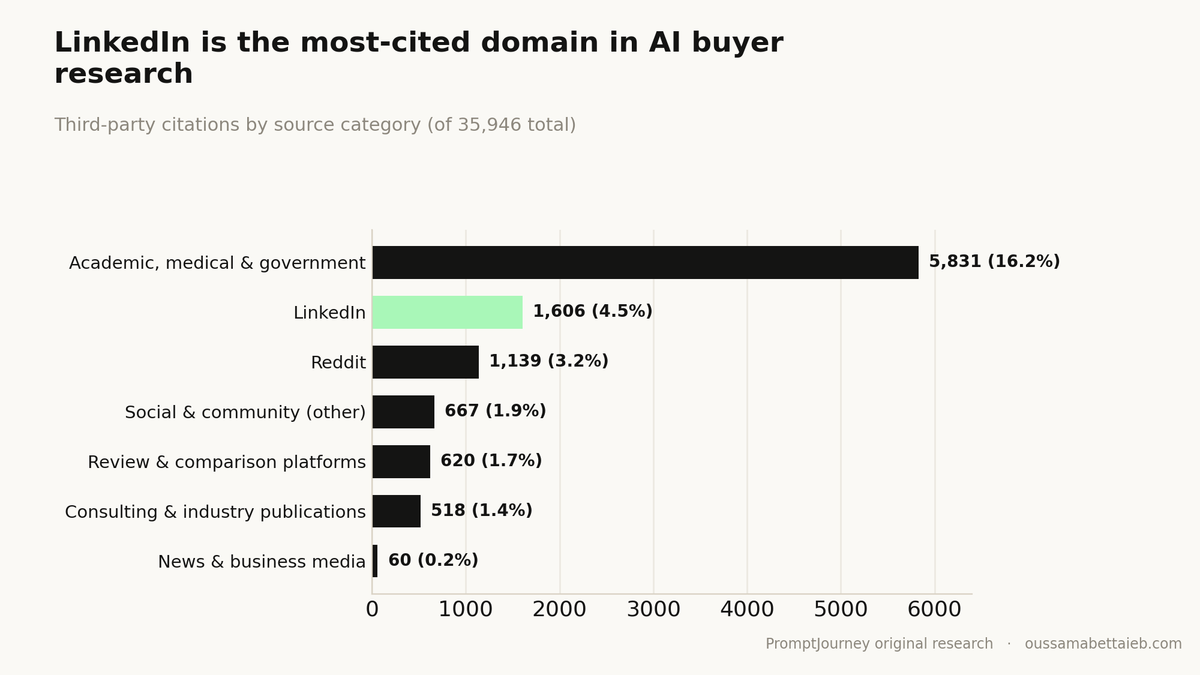
Fig. 1: Third-party citations grouped by source category, out of 35,946 total. LinkedIn and Reddit are shown individually; every other domain is clustered by type.
The academic cluster is larger in aggregate, but it is a coalition of dozens of databases and journals. As a single destination the models return to, nothing beats LinkedIn.
For marketers: LinkedIn is not just a distribution channel anymore. It is the single largest independent source AI assistants read when they research your category. What exists there about you, and about your competitors, shapes the answer buyers receive.
Finding 2: The AI researches people, not companies, especially at decision time
Break the 1,606 citations down by what kind of LinkedIn page they point at, and the pattern is unambiguous. Individual feed posts take 48%. Personal profiles take another 39%. Long-form Pulse articles get 8%. Company pages, the destination most brands pour their LinkedIn effort into, get 3%.
87% of LinkedIn citations point at individual people. Company pages get 3%.
The stage split sharpens the story. Unlike Reddit, LinkedIn citations climb through the funnel, from 442 at awareness to 560 at consideration to 604 at decision, and personal profiles skew hardest of all: 44% of profile citations land at the decision stage. Late in the journey, once a shortlist exists, the models go looking for the actual humans behind the options, the founders, consultants, and practitioners, and read their profiles as a final credibility check.
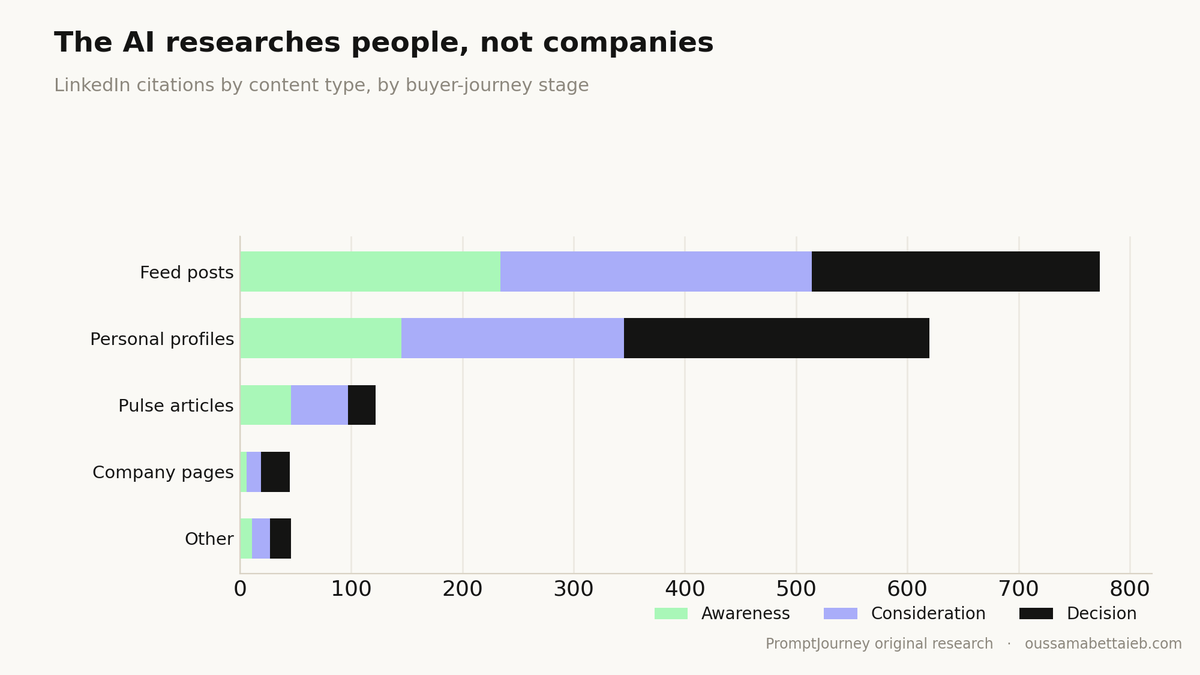
Fig. 2: LinkedIn citations by content type, decoded from URL structure, split by buyer-journey stage. Profiles are the most decision-weighted format.
For marketers: Your company page is nearly invisible to AI research; your people are not. Your founders and practitioners profiles are your decision-stage collateral. Treat the headline, about section, and recent activity as conversion assets, not HR formalities. This per-persona, per-stage citation map is exactly what I built Prompt Journey to produce.
Finding 3: LinkedIn is the proof platform, results not questions
Classifying the search queries that led to each LinkedIn citation with the same rules I used for Reddit reveals a mirror image. On Reddit the dominant classified theme was pricing gossip; on LinkedIn it is results and timelines, meaning ROI numbers, case studies, and success stories, with 362 citations, where the same theme mustered just 100 across all of Reddit. How-to and pricing queries spike at decision, consistent with a buyer verifying feasibility and cost right before choosing.
The content format flips too. On Reddit, 53% of everything cited was a question thread. On LinkedIn, questions are just 17% of cited titles. What gets cited instead are declarative practitioner posts: benchmark write-ups, here-is-exactly-what-I-would-do breakdowns, and growth teardowns with numbers in them.
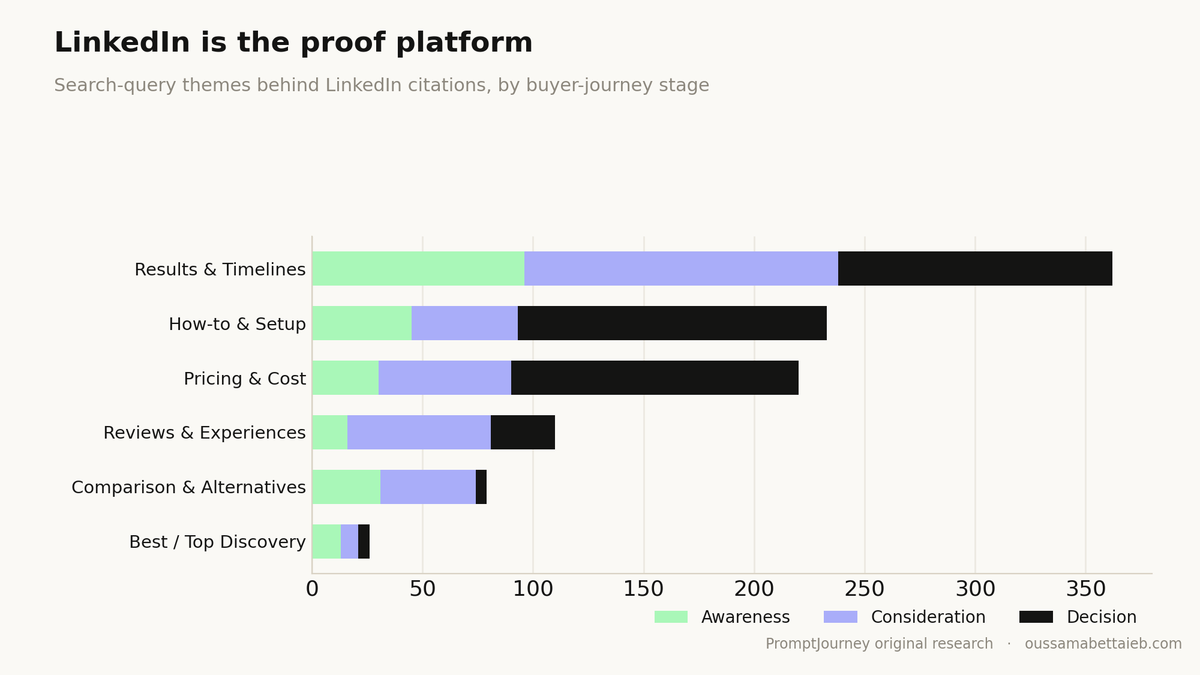
Fig. 3: Search query themes behind LinkedIn citations, split by buyer-journey stage. Same classification rules as the Reddit report, for comparability.
For marketers: Reddit rewards asking; LinkedIn rewards showing. Posts with concrete results, meaning benchmarks, timelines, before-and-after numbers, and named tools, are what the models retrieve as evidence. Opinion posts without numbers do not feed the proof query.
Finding 4: Reactions do not buy citations
Does virality matter? To test it, I collected live reaction counts for the 25 most-cited LinkedIn posts in the dataset (24 were still accessible). If engagement drove retrieval, it would show up in exactly this group, the posts the models loved most. It does not.
The correlation between citation count and reactions is r = -0.15, statistically nothing. The median top-cited post has 42 reactions, 54% have fifty or fewer, and not one exceeds a thousand. The single most-cited post in the entire corpus, with 26 citations, more than any Reddit thread managed, is a solo practitioner feed post about digital marketing for blue-collar businesses, sitting at 37 reactions.
The most-cited post in the entire dataset has 37 reactions.
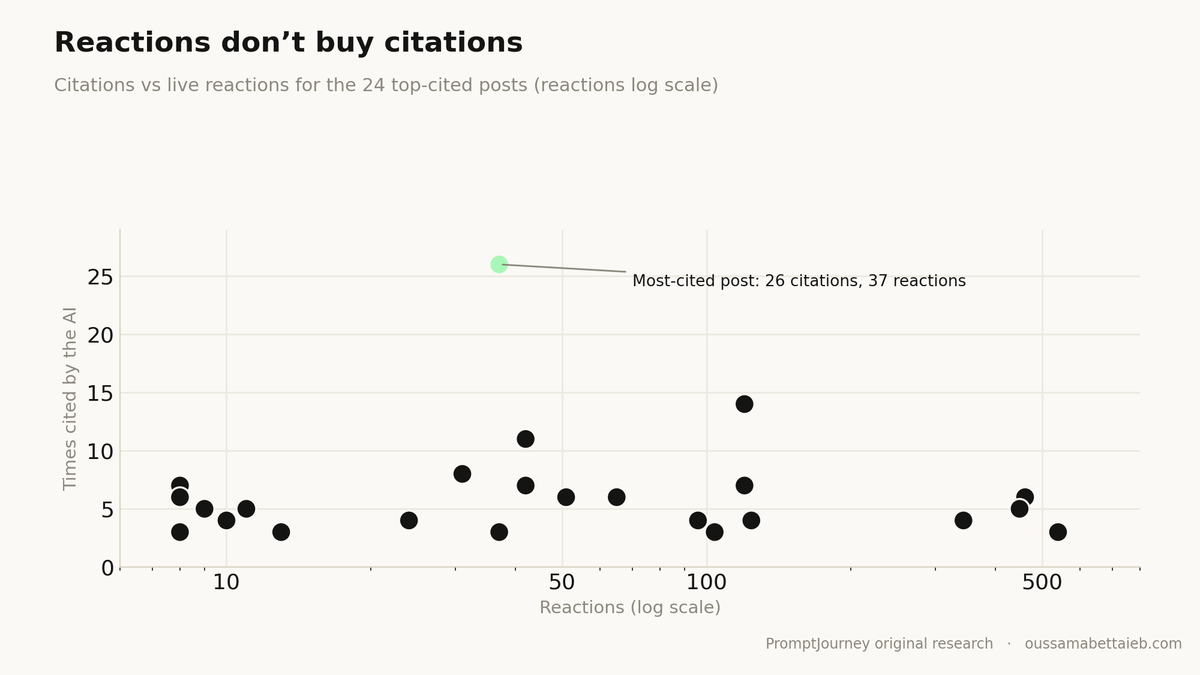
Fig. 4: Citation count against live reaction count for the 24 accessible top-cited posts, reactions on a log scale, collected July 2026. No relationship.
This is the same result I found on Reddit, where 44% of cited posts had five or fewer upvotes (r = 0.02). The mechanism is identical: AI search retrieval runs on textual relevance to the query, not on social proof signals.
For marketers: Stop optimising LinkedIn posts for the algorithm and start optimising them for the query. A 30-reaction post that squarely answers what results a buyer can expect will out-cite a 5,000-reaction engagement-bait carousel every time.
Finding 5: The citation window is about 18 months
LinkedIn feed-post URLs carry their own timestamp, because the long activity ID encodes the exact publication moment, which let me date 555 of the 1,304 unique cited URLs without any API. The result is even more recency-skewed than Reddit: 95% of datable cited posts were published within the last 18 months. Posts from 2024 barely register, and 2023 appears exactly once.
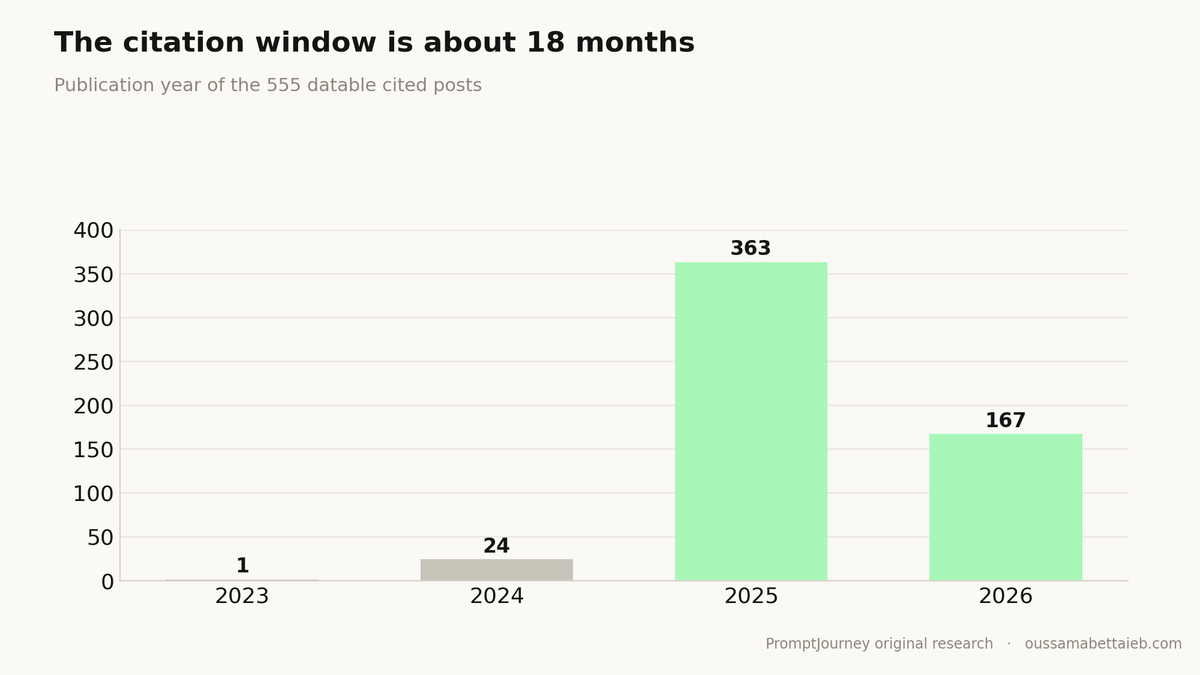
Fig. 5: Publication year of the 555 datable cited posts, feed posts only, since profiles and articles carry no timestamp. Data collected July 2026.
Reddit threads had a citation half-life of a couple of years; a LinkedIn post is closer to a couple of quarters. The feed decays fast, and AI retrieval decays with it.
For marketers: LinkedIn visibility in AI answers is a subscription, not a purchase. It lapses unless practitioners keep publishing. A great post from two years ago is effectively invisible; cadence beats archive.
Finding 6: For B2B it is essential, for B2C it barely exists
Reddit showed a 3.3x gap between B2B and B2C personas. LinkedIn more than doubles it: 34.9% of B2B conversations retrieved LinkedIn, against 4.7% of B2C conversations, a 7.4x skew, the most lopsided platform split in my entire dataset.
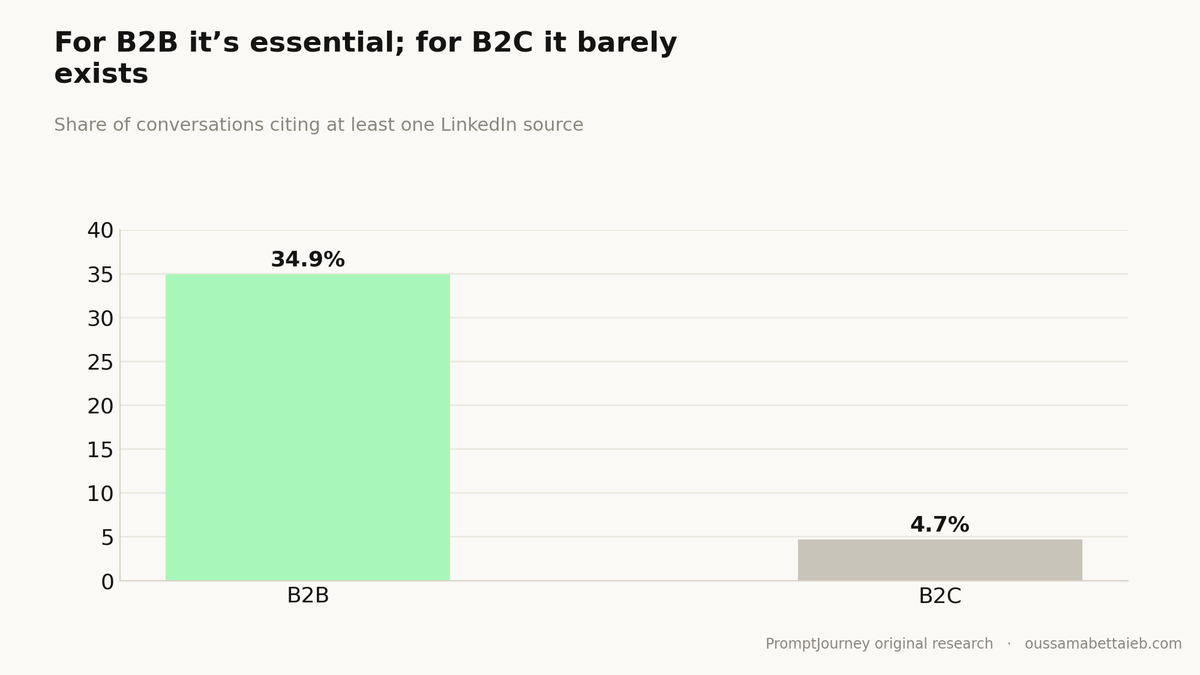
Fig. 6: Share of conversations retrieving at least one LinkedIn source, by persona buyer type. 90 B2B personas and 1,466 conversations against 24 B2C personas and 362 conversations.
It also enters early: in 44% of LinkedIn-citing conversations it appears on the very first search turn, and 76% by turn two, the same first-reach behaviour Reddit shows. For professional purchases, checking LinkedIn is evidently a reflex, not a fallback.
For marketers: If you sell to businesses, LinkedIn is a primary input into how AI describes your category. Invest accordingly. If you sell to consumers, your AI-visibility budget is better spent on review platforms, publishers, and health and finance databases.
Finding 7: Reddit and LinkedIn arrive together, one sweep and two lenses
I assumed the two platforms would trade off, with Reddit early for peer opinion and LinkedIn late for proof. The data says something more interesting. 284 conversations cite both platforms, which is 66% of every Reddit-citing conversation and 54% of every LinkedIn-citing one. And in 76% of those co-citing conversations, both platforms first appear on the same search turn. Reddit-first at 34 conversations against LinkedIn-first at 35 is a dead heat.
In other words, the models do not choose between them sequentially. One search sweep pulls both, as two halves of a single what-do-real-people-say check: the anonymous practitioner consensus from Reddit, and the named-professional evidence from LinkedIn. Within co-citing conversations LinkedIn out-cites Reddit by roughly 1.3x at every stage. Co-citing is also almost exclusively a B2B behaviour: 19.2% of B2B conversations cite both platforms, against 0.6% of B2C conversations.
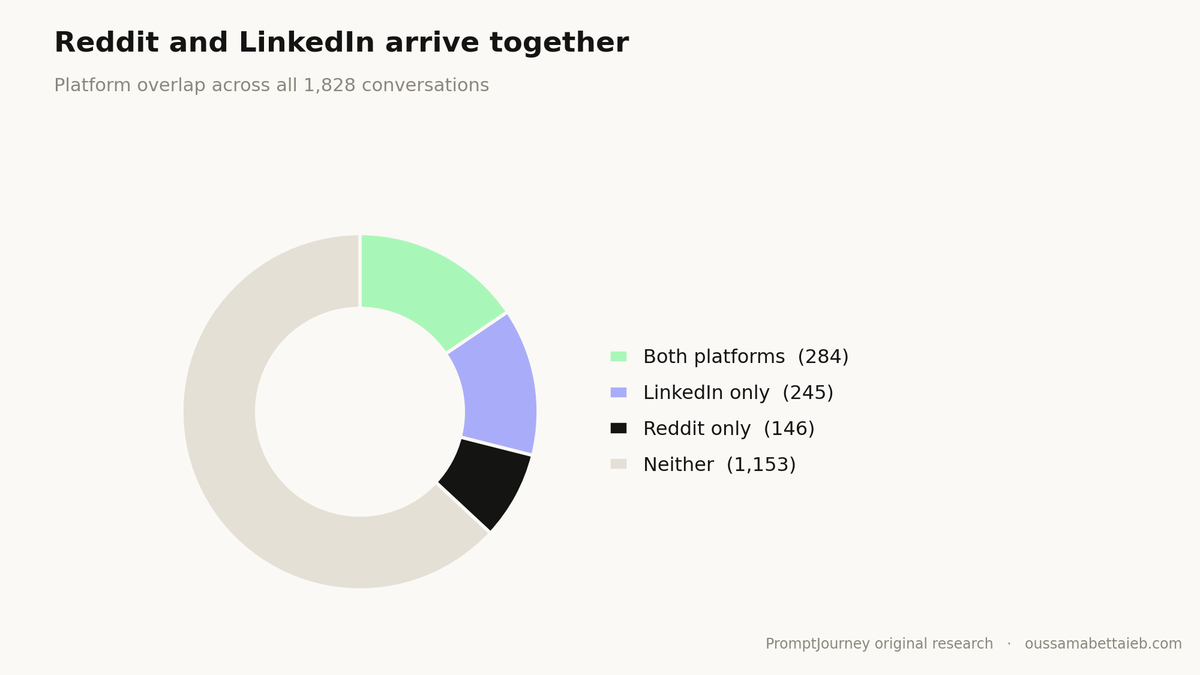
Fig. 7: Left, platform overlap across all 1,828 conversations. Right, citations per platform per stage, within the 284 conversations that cite both.
For marketers: Do not run Reddit and LinkedIn as competing channel bets. The AI reads them as one social-proof layer. The strongest position is coverage on both: peer discussion of your category on Reddit, and named practitioners publishing results on LinkedIn, answering the same buyer question from two directions. Mapping that coverage per persona is the core of what Prompt Journey does.
Methodology and limitations
This analysis is based on Prompt Journey's persona-simulation pipeline: AI-generated buyer personas conduct multi-turn research conversations using web-search-enabled language models, staged across awareness, consideration, and decision. Every source retrieved by the model during search is logged with its URL, title, snippet, and originating query.
Sample: 1,828 conversations, 73 research runs, 114 personas, and 35,946 total source citations, of which 1,606 were LinkedIn URLs, 1,304 of them unique. Data collected through July 2026. This is the same underlying dataset as The Reddit Citation Effect.
URL decoding: LinkedIn exposes no public data API, so content types and authors were derived from URL paths, and publication dates from feed-post activity IDs, which embed a millisecond timestamp. 555 of 1,304 unique URLs were datable this way; profiles, articles, and company pages carry no timestamp.
Engagement: reaction counts for the 25 most-cited posts were collected manually from live pages in July 2026, with 24 accessible and one access-restricted. This is a small, deliberately biased sample, so it tests whether virality is necessary for citation, not the full engagement-to-citation relationship.
Classification: query themes and title formats were classified with keyword rules; counts are directional rather than exact.
Limitations: these are simulated buyer conversations, not logs of real ChatGPT or Perplexity users. The sample skews B2B, at 90 of 114 personas, and reflects the categories my customers ran: professional services, marketing technology, healthcare, and consumer aesthetics. Retrieval behaviour may differ across model families and search providers. Client brands, persona identities, and individual LinkedIn authors are anonymised throughout.
Correlations reported are Pearson r on raw values. Citation means one retrieved-source entry in one conversation, deduplicated per conversation where noted.
Do you know what AI says about your brand? Prompt Journey recreates your buyers AI research journeys and shows you exactly which sources, and which competitors, get cited along the way, persona by persona. It is in early access now. Join the waitlist and I will get you in.