Every AI visibility conversation I have ends up in the same place. Someone opens ChatGPT, types their own brand name, and reads the answer back to me. Sometimes it is a whole dashboard of branded prompts and bottom-of-funnel comparisons, tracked weekly.
The problem with that test is that it only works on buyers who already know you exist, and those are not the buyers you need to win. Someone who has never heard of you does not type your name. They type their problem. If you are missing from that answer, you never reach the shortlist where the branded prompt would have saved you. So the measurement that feels the most reassuring is the one that tells you the least, and I kept meeting teams optimising against it.
I wanted to know how big that blind spot actually is. So I took the 533 conversations in my corpus that ran on ChatGPT models, out of the 1,828 behind The Reddit Citation Effect and The LinkedIn Citation Effect, and split every prompt into branded and non-branded to see where company citations really come from. While I was in there I also pulled live SEO data for the domains and the exact pages ChatGPT cited, to test the other assumption sitting underneath most GEO advice: that this is just SEO with extra steps.
Six findings follow. The first one changed how I brief clients.
Key takeaways
- Only 7% of analyzed buyer prompts name a company. If your AI visibility tracking is a list of branded and bottom-of-funnel prompts, you are auditing 7% of the surface.
- 83% of every company citation happened inside a generic prompt. Branded prompts convert better per prompt (95% against 45%), but they are 37 prompts out of 530. Volume beats hit rate.
- Reddit is ChatGPT's most-cited source, and it concentrates on comparisons. A branded or comparison prompt pulls 7.4 Reddit citations on average against 1.5 for a generic one.
- ChatGPT cites trusted domains, but not pages that rank. The exact URLs it pulls average a handful of Google visits a month, and many get zero. Citation is not ranking.
- Funnel stage changes how often you are cited, not whether. Coverage is flat at 12 to 13% across awareness, consideration and decision. Depth rises 83% once buyers leave awareness.
- Buyer psychology barely matters. Who the buyer is matters a lot. Decision-making style moves nothing. B2B against B2C is a 7x gap, and executive buyers surface the brand in 27% of conversations against 0% for junior ones.
The findings at a glance
- Finding 01: Almost nobody asks about you by name. 7% of analyzed prompts are branded, but 83% of company citations come from the other 93%. Track the questions your category owns, not the ones with your name in them.
- Finding 02: Reddit is ChatGPT's most-cited source and it spikes on comparisons. 999 citations, all 14 brand runs. 7.4 citations per branded prompt against 1.5. Reddit is a shortlist play, not an awareness play.
- Finding 03: ChatGPT cites trusted domains. Cited domains cluster at very high Domain Rating, with rare thin-site exceptions. Domain trust is the entry ticket. Borrow it if you cannot build it yet.
- Finding 04: But not the pages that rank. Most-cited page gets ~2,036 Google visits a month. Many cited pages get zero. Write the page that answers the question completely, not the page that ranks.
- Finding 05: Funnel stage moves depth, not coverage. Coverage 13 / 13 / 12%. Citations 41 / 75 / 69, an 83% depth rise. Solve presence before you solve depth, and start at awareness.
- Finding 06: Who the buyer is beats how the buyer thinks. Psychology flat at 12 to 13%. B2B 15% against B2C 6%, executives 27% against juniors 0%. Segment your AI visibility work by buyer profile, not by persona psychology.
Finding 01: Almost nobody asks about you by name
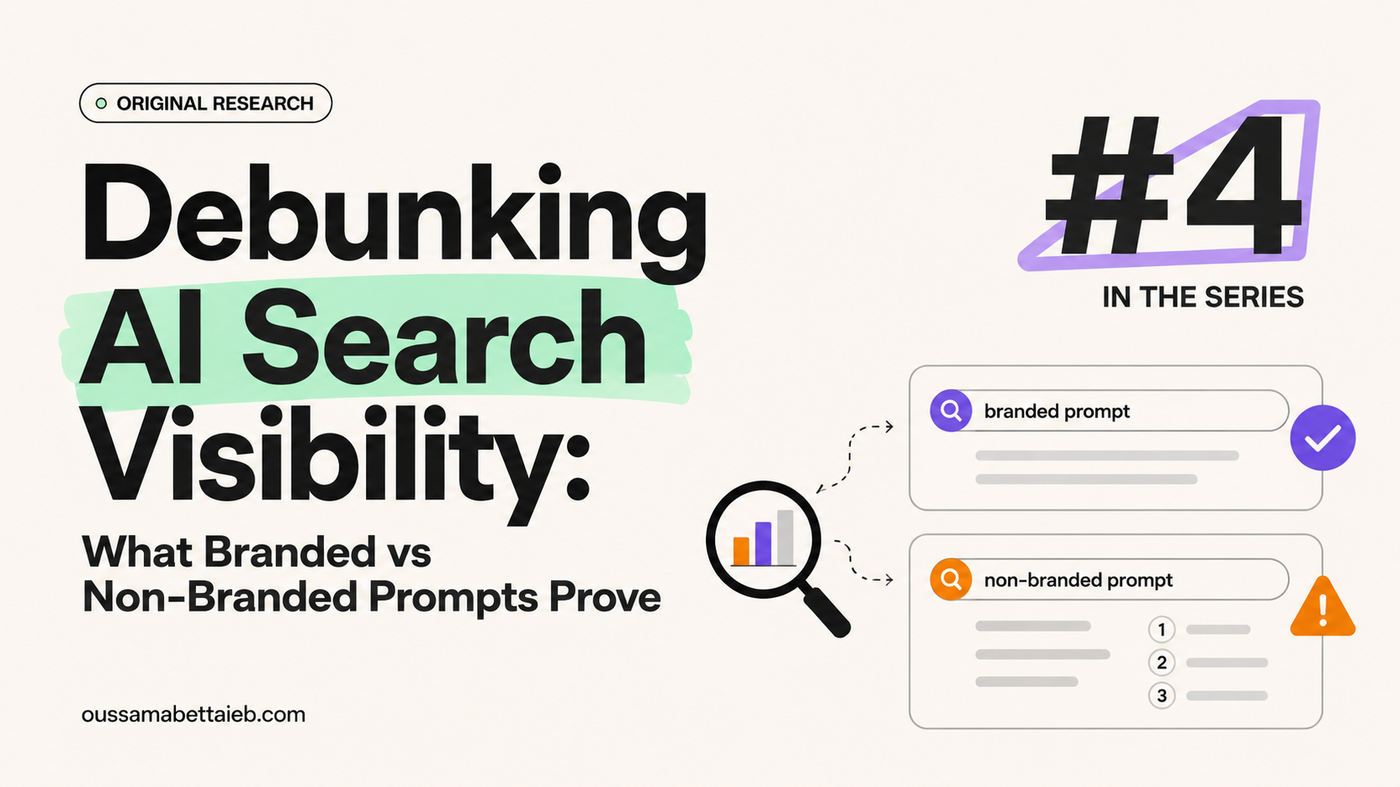
A branded prompt is one whose text explicitly names a company I track, either the brand itself or one of its competitors. Out of 530 classified prompts, 37 are branded. That is 7%. The other 493, 93% of everything buyers asked, are generic questions with no company in them at all.
This matters because branded prompts are where the industry does its testing. Type your brand into ChatGPT, see what comes back, screenshot it. It feels like measurement. It is closer to a mirror.
Branded prompts do behave well. 95% of them surface a tracked company, 35 out of 37. Name a company in the question and one almost always shows up in the answer. Non-branded prompts convert at 45%, 224 out of 493, a much lower hit rate per prompt.
But hit rate is not the number that matters. Volume is. Of the 1,862 citations pointing at a tracked company across the whole dataset, 318 came from branded prompts and 1,544 came from non-branded ones. 83% of every company citation in the corpus happened inside a question that never mentioned a company.
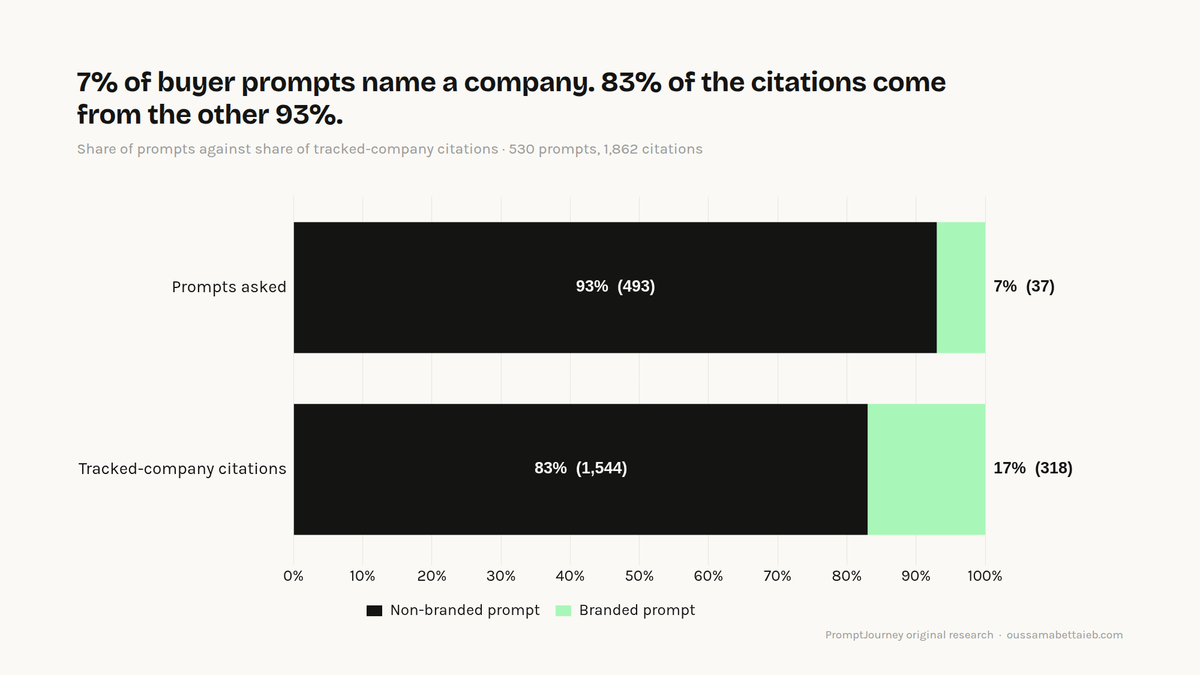
The debunk. A branded prompt will almost always return your brand, because you put the name in the question. But most of your market has not heard of you yet, so they never ask that question. Track only branded prompts and you are measuring the answer you already know, while missing the overwhelming majority of the searches your ICP actually runs.
For marketers. Stop scoring yourself on "what does ChatGPT say about us". Score yourself on the questions your buyers actually type, the ones where your category is the subject and your name is not. That is where 83% of the citations are, and it is the only version of the test your competitors can lose.
Finding 02: Reddit is ChatGPT's most-cited source, and it spikes exactly where you are being compared
Across the full corpus, LinkedIn was the most-cited domain and Reddit came third. Narrow to the ChatGPT conversations and Reddit takes the top spot outright, 999 citations, appearing in all 14 brand runs without exception. No category avoided it. That reordering is worth noting on its own: which social platform dominates is partly a property of the assistant, not of AI search in general.
By raw count it looks like a background source: 726 of those citations, 73%, came from non-branded prompts, against 273 from branded ones. That reads as broad and shallow.
Weight it per prompt and the shape flips. A branded prompt pulls 7.4 Reddit citations on average. A non-branded prompt pulls 1.5. Roughly a five-fold concentration. Ask ChatGPT to compare three named competitors and it does not go to any of the three websites first. It goes and reads the thread where people argued about all three.
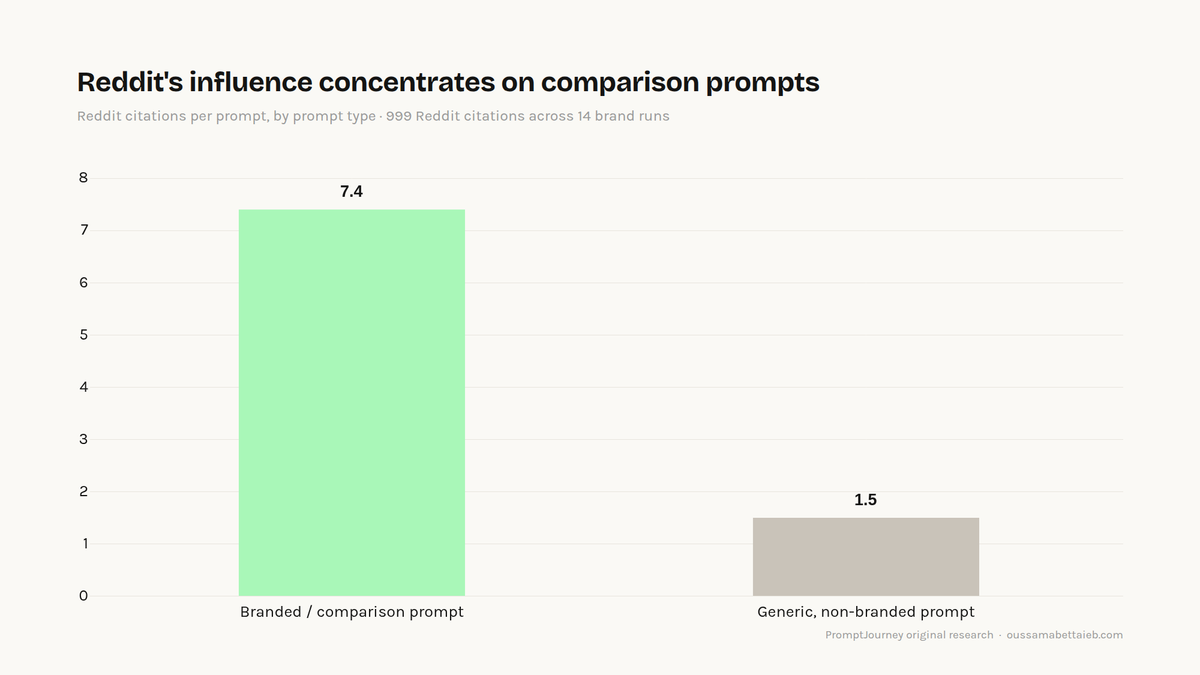
This lines up with what I found in The Reddit Citation Effect, where pricing and comparison queries clustered at the decision stage, and it sharpens it. Reddit's footprint is everywhere. Reddit's influence concentrates on head-to-head comparison, which is the moment a shortlist becomes a purchase.
For marketers. Reddit is not an awareness play, it is a shortlist play. Find the threads where your category gets compared by name and make sure the version of your product being described there is the current one. If your competitor is in that thread and you are not, the model has already made the comparison without you. I wrote up how to work those communities without getting your account nuked in The Reddit Playbook for AI Search Visibility, and this finding is the reason the comparison threads sit at the top of that list.
Finding 03: ChatGPT cites trusted domains, but not the pages that rank
Here is where I expected the data to confirm the conventional view and it only half did.
At the domain level, ChatGPT is conservative to the point of being boring. The domains it cites most are the ones you would guess: the large community and social platforms, each pulling over a billion monthly organic visits, the major academic and medical databases in the tens of millions, a top-tier management consultancy at 943K, a large B2B review site at 688K. Established, very high Domain Rating, enormous. Domain trust is clearly doing work.
Then there are the exceptions, and they are not rounding errors. A niche vendor site with 2,844 monthly visits gets cited. Another with 1,703. One with 95 monthly visits was cited 35 times inside a single category. Thin sites do get through when they are topically dead on.
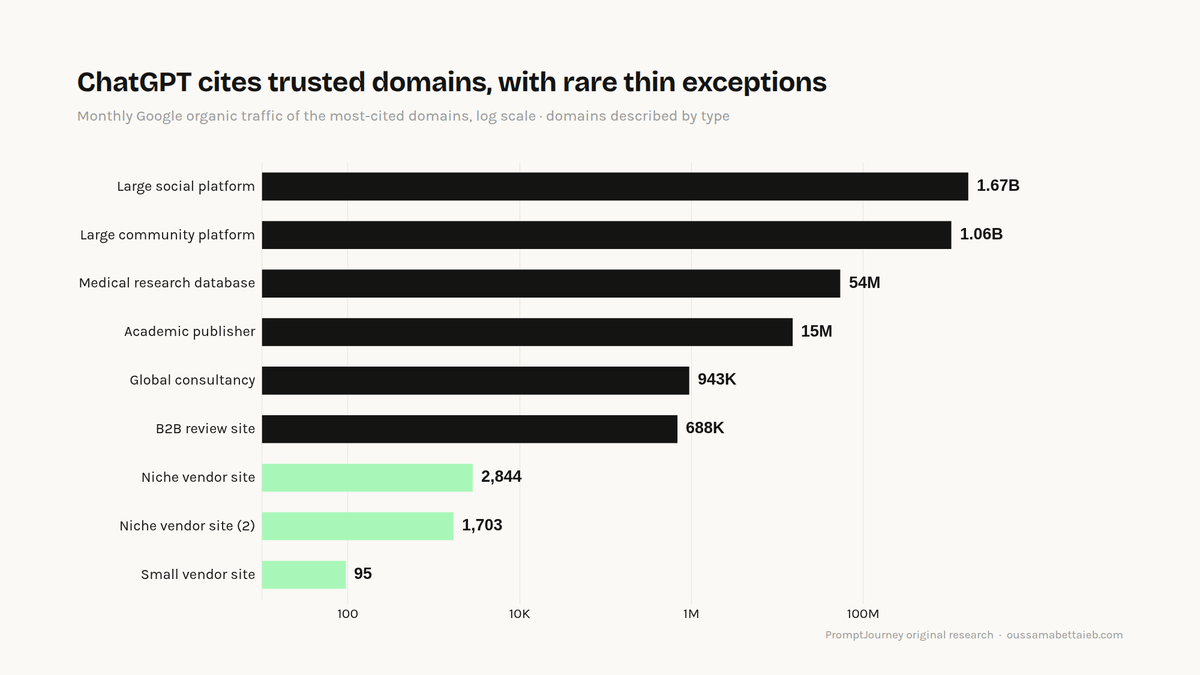
For marketers. Domain trust is the entry ticket, and it is slow to buy. But it is not a gate you have to pass alone. If your own domain is not there yet, the fastest route into an answer is a page on a domain that already is: a category listing, a comparison roundup, a community thread, an analyst or review page. Borrowing trust is faster than building it.
Finding 04: The exact pages it cites get almost no Google traffic
This is the finding I would put on a slide if I only got one.
Having checked the domains, I checked the specific URLs. Not "does this domain rank", but "does this exact cited page rank". The answer is almost uniformly no.
The single most-cited page in the entire set, a cloud platform's roundup of real-world generative AI use cases, gets around 2,036 organic visits a month and carries a URL Rating of 16. That is the top of the distribution. Below it: a global consultancy's research piece on AI at work at 222 visits, an academic journal article at 65, a category roundup on a large consumer platform at 33, a vendor's own "best software in the category" listicle at 9, a review site's category page at 7. Then a long tail sitting at exactly zero. URL Ratings across the cited pages run from 0.0 to 36, and most sit in single digits.
- Cloud platform, generative AI use-case roundup: URL Rating 16, 2,036 organic visits/mo.
- Global consultancy, AI at work research: URL Rating 36, 222 organic visits/mo.
- Academic journal article: URL Rating 4.5, 65 organic visits/mo.
- Consumer platform, category roundup: URL Rating 9.0, 33 organic visits/mo.
- Vendor listicle, best software in category: URL Rating 4.4, 9 organic visits/mo.
- B2B review site, enterprise category page: URL Rating 4.6, 7 organic visits/mo.
- Enterprise vendor, customer stories: URL Rating 6.0, 0 organic visits/mo.
- Community forum thread: URL Rating 0.0, 0 organic visits/mo.
- Small vendor, category listicle: URL Rating 0.0, 0 organic visits/mo.
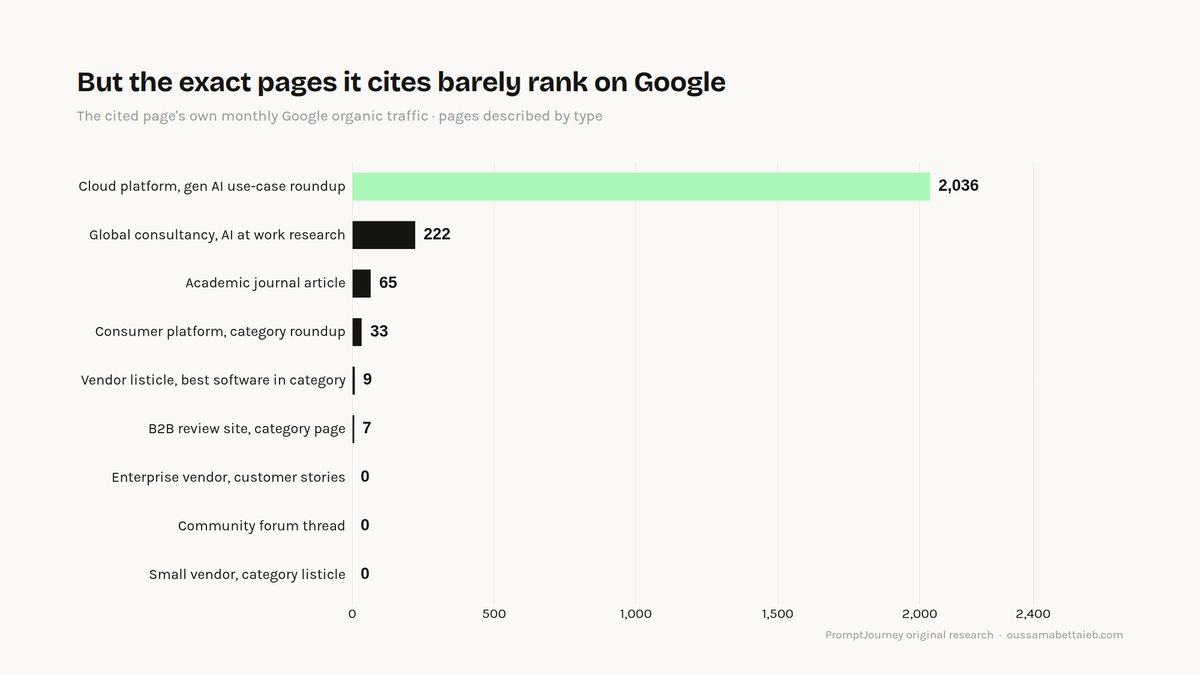
These are not pages winning on Google. Several of them are invisible on Google. They are being retrieved because they are topically precise on trusted domains, and for no other reason.
The gap. Reputable domains, near-zero-traffic pages. Winning ChatGPT citations is not the same game as ranking. It rewards topically relevant content on trusted domains, including pages Google barely surfaces.
For marketers. This is the most useful gap in the market right now, because it is cheap to exploit. You do not need a page that outranks anyone. You need a page that answers one specific buyer question completely, published somewhere the model already trusts. The pages that win here are the ones an SEO team would deprioritise for having no search volume.
I want to be careful about how far I push this. It does not mean SEO is irrelevant, domain authority clearly matters, and it does not mean you should stop building pages that rank. It means the ranking of the individual page is not the mechanism, and if you brief a content team on ranking alone you will systematically underproduce the pages that get cited.
Finding 05: Funnel stage changes how often you are cited, not whether
I split the brand's own citations across awareness, consideration, and decision, with a near-identical number of conversations in each: 178, 178, 177.
Coverage, the share of conversations that mention the brand at all, is almost perfectly flat: 13% at awareness, 13% at consideration, 12% at decision. Getting closer to a purchase does not make ChatGPT more likely to mention you.
Depth is a different story. Brand citations run 41 at awareness, 75 at consideration, 69 at decision. That is an 83% jump from awareness to consideration, and it holds through to decision. Per cited conversation, the brand is named 1.8 times at awareness against 3.3 times at consideration. Once you are in the answer late in the funnel, you are in it repeatedly.
Stage decides how loudly you are cited, not whether you are cited at all.
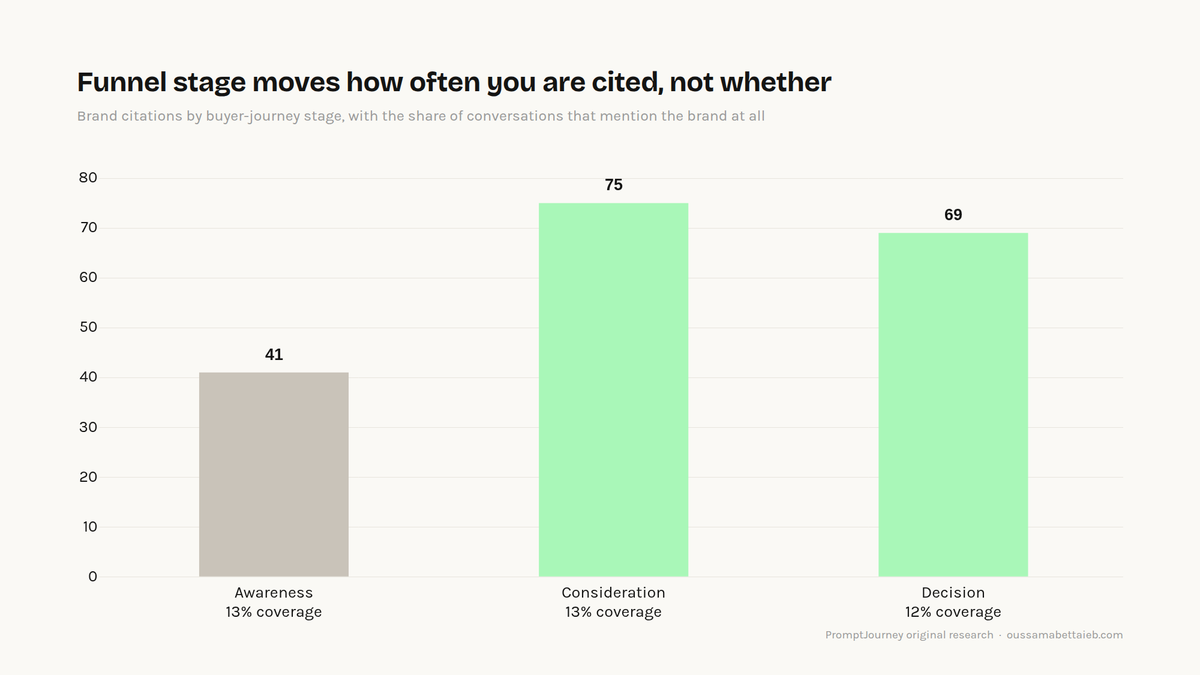
So the two levers are separate. Whether you get mentioned appears to be decided by something structural, and awareness is where mentions are thinnest in absolute terms. That makes top-of-funnel the clearest gap to close, which is the opposite of where most brands aim their AI visibility effort.
For marketers. Treat coverage and depth as two different problems. Coverage is a presence problem, solved by existing in the sources the model reads about your category. Depth is a substance problem, solved by there being enough specific material about you to cite more than once. Most brands are working on depth for a stage where they have not solved coverage.
Finding 06: Buyer psychology barely moves the needle. Who the buyer is moves it a lot.
Every conversation is driven by a distinct buyer persona, so I grouped brand citations by the persona's decision-making style, the core psychological archetype.
It does almost nothing. Data-driven personas: 12% coverage, 3.0 brand citations per cited conversation. Intuition-led: 13% coverage, 2.1 citations. Consensus-seeking: 13% coverage, 3.0 citations. Coverage sits between 12% and 13% across all three archetypes. Risk profile shows the same near-flat pattern. The only visible effect is that intuition-led personas cite the brand around 30% less deeply, which is interesting but small.
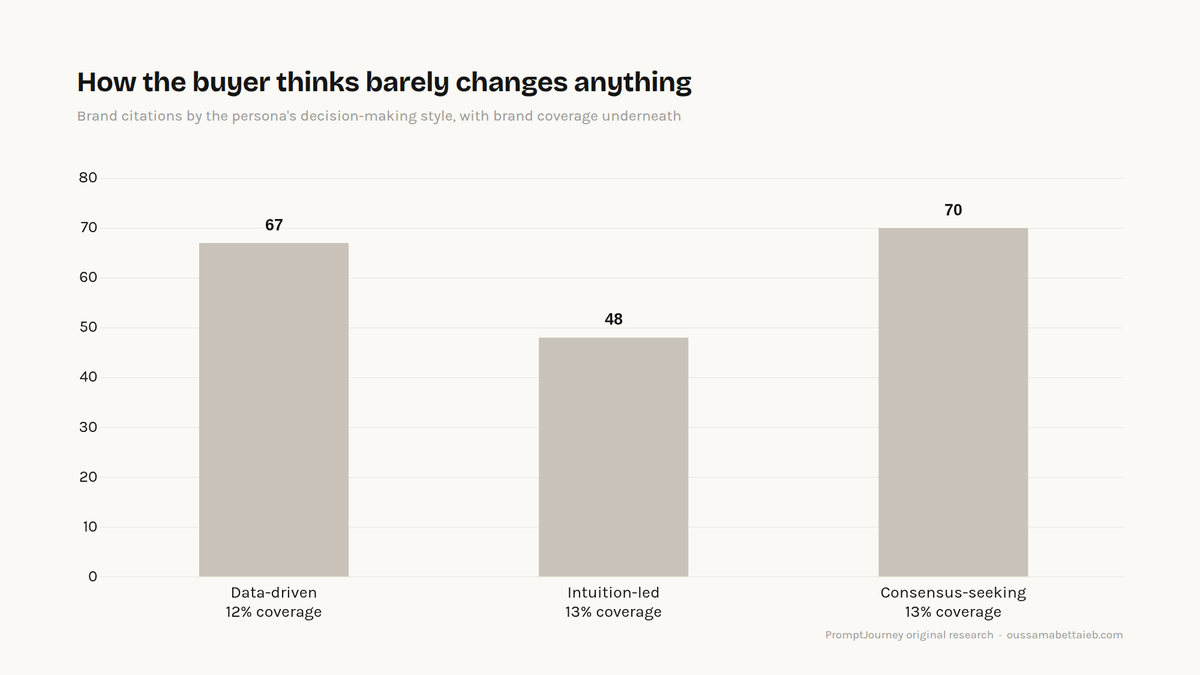
The dimension that actually swings brand mentions is structural, not psychological.
B2B against B2C. 426 B2B conversations mention the brand 15% of the time, producing 179 brand citations, 0.42 per conversation. 107 B2C conversations mention it 6% of the time, producing 6 citations. Per conversation, B2B personas cite the brand roughly 7 times more often. That is the third consecutive report where B2B and B2C separate sharply on the same axis, after the 3.3x Reddit gap and the 7.4x LinkedIn gap in reports №01 and №02.
Seniority. Executive-level buyers surface the brand in 27% of their conversations. Senior 16%, mid-level 11%, C-suite 7%, junior 0%. The gradient from executive down to junior is steep and consistent, with one wrinkle I will not explain away: C-suite sits below mid-level, on 60 conversations, and junior is a 15-conversation cell. Those two are small enough that I would not build a strategy on them. The executive-to-mid-level trend is on 351 conversations and I would.
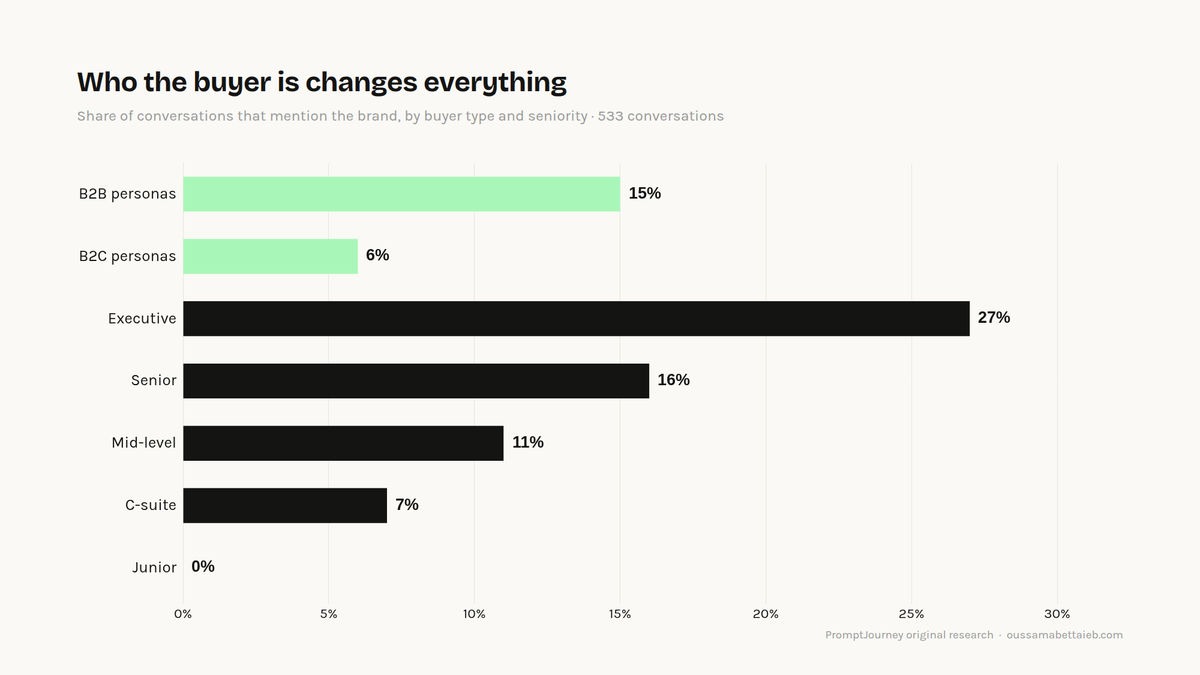
For marketers. Focus on who your buyers are, because ChatGPT clearly changes the way it answers based on the profile in front of it. The same category question asked by an executive B2B buyer and by a junior or consumer one comes back with different sources and a very different chance of your name appearing at all. Segmenting by buyer psychology looks sophisticated and moves almost nothing. Segmenting by buyer profile moves everything, so map your visibility against your real buyer rather than against a category average. That per-persona map is exactly what I built PromptJourney to produce.
Methodology and limitations
This analysis uses PromptJourney's persona-simulation pipeline. AI-generated buyer personas run multi-turn research conversations with web-search-enabled language models, staged across awareness, consideration, and decision. Every source the model retrieves during search is logged with its URL, title, snippet, and originating query.
Sample. The 533 conversations in the corpus that ran on ChatGPT models, drawn from the same 1,828-conversation dataset behind The Reddit Citation Effect and The LinkedIn Citation Effect, across 14 brand runs and roughly 11 brands, producing 15,631 source citations. 99% of conversations retrieved at least one source. Categories covered marketing technology, product information management, recruitment, wedding services, and consumer e-commerce. Client brands, cited vendor pages, and persona identities are anonymised or described by type throughout. SEO enrichment collected August 2026.
Branded-prompt classification. A prompt counts as branded when its text explicitly names the brand or one of its tracked competitors. Generic-word brand names can cause minor misclassification, so treat the 7% as directional.
SEO enrichment. Domain Rating, URL Rating, organic traffic, and keyword data were pulled live from Ahrefs at the time of writing. Traffic figures are Ahrefs estimates of Google organic visits, not measured analytics.
Persona attributes. Decision-making style, risk profile, buyer type, and seniority come from each persona's own profile. "Brand cited" counts sources matching that run's primary domain.
Limitations. These are simulated buyer conversations, not logs of real ChatGPT users. This corpus runs on ChatGPT models only, so retrieval behaviour may differ on other model families and search providers. Brand self-citation is low in part because these runs skew towards smaller brands, so read the ~13% coverage figure as a floor for challenger brands rather than a category norm. Several persona cells, particularly C-suite and junior, are small enough to be unstable. Query and prompt classification used keyword rules, so counts are directional rather than exact.
The through-line
AI retrieval does not reward the things marketing teams are set up to produce. Reddit citations ignored upvotes. LinkedIn citations ignored reactions. ChatGPT citations largely ignore whether the page ranks. What they all reward is being topically exact in a place the model already trusts, on the questions your buyers actually ask, which are almost never questions about you. 93% of the prompts in this dataset never said a company name. If your AI visibility programme is built on typing your own brand into an assistant and reading the answer, you are looking at the 7% and missing where it is decided.
Do you know what AI says about your brand?
This report is one slice of what I see running these simulations every day. PromptJourney recreates your buyers' AI research journeys and shows you exactly which sources, and which competitors, get cited along the way, persona by persona.
It's in early access right now. If that's a gap you're trying to close, join the waitlist and I'll get you in.