Over my last two reports I pulled apart 1,828 AI buyer-research conversations to see how AI assistants actually use Reddit and LinkedIn when someone researches a purchase. The Reddit one found something I couldn't stop thinking about: Reddit is the third most-cited source in those conversations, and what gets cited isn't the biggest or most-upvoted thread. It's the most recent, on-topic question thread in a niche community.
Interesting on its own. But the question I kept getting afterwards was simpler: okay, so what do I actually do with that?
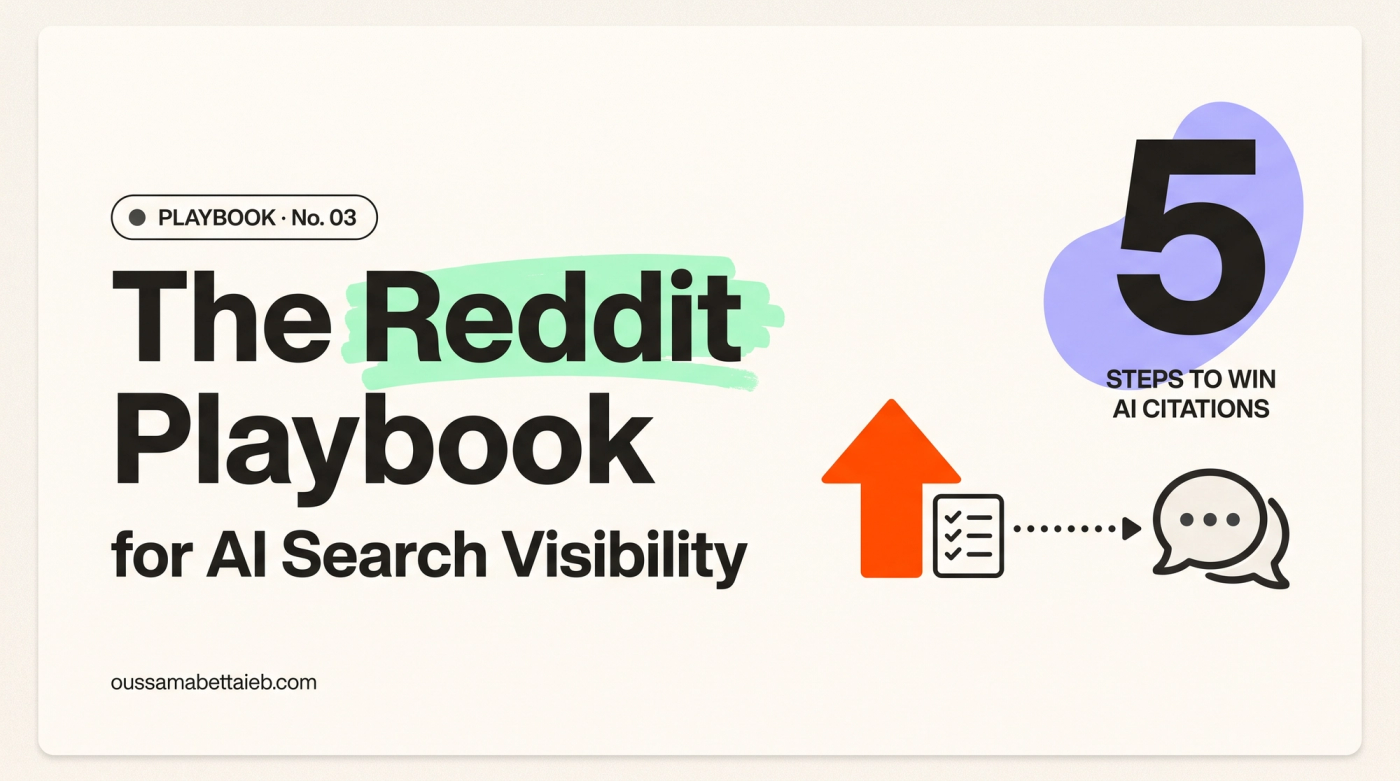
This is my answer. Not a list of growth hacks, and not “post more on Reddit.” It's the working process I use to show up in the threads AI actually reads, without the parts that get your brand shamed in the comments.
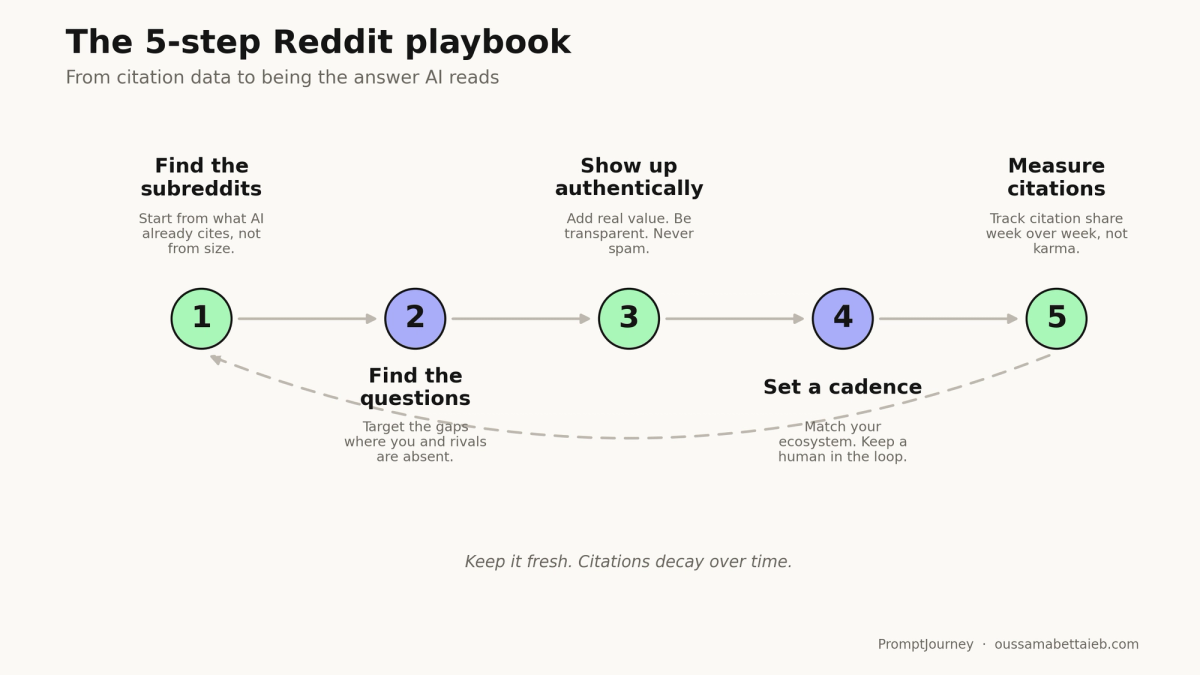
The five moves:
- Find the right subreddits, starting from what AI already cites, not from community size.
- Find the open questions where you and your competitors are both absent.
- Show up authentically, because salesy comments get shamed and that sentiment is what the AI reads.
- Set a cadence you can keep, since Reddit citations decay fast.
- Measure citation share week over week, not karma.
This playbook comes out of what I see running Prompt Journey every day. To see which conversations already cite Reddit around your brand, and where you're missing, join the early-access waitlist.
First, the mindset
Let me correct something before we start, because I keep seeing people swing too far the other way.
The shift isn't “optimise for AI retrieval instead of engagement.” It's not this or that. It's both, in balance.
Here's what I mean. AI retrieval is real and it's powerful. When someone asks ChatGPT's search mode about your category, the model goes and reads the web, and a big share of the time it reaches for Reddit, because LLMs trust threaded, human discussion. So the more genuinely present you are in the relevant communities and the relevant posts, the more you increase your chances of landing in that answer.
But that doesn't mean you abandon good Reddit marketing. If you're already doing great work on Reddit itself, being useful, respecting the community, you're most of the way there. The AI-retrieval layer just sits on top of that. You keep doing the human thing well, and you add one question: am I showing up for the prompts and topics my buyers are actually asking AI about?
That balance is the whole game. Here's the five-step version of how I hold it.
Step 1: Find the right subreddits
Community size isn't the filter. Relevance is. (The research backed this up: tiny professional subreddits out-cited million-member giants.) So I don't start from “the big subreddits in my space.” I start from evidence.
Here's my actual process when I'm doing this for AI retrieval. I look at the conversations and prompts I'm tracking, and I see which Reddit posts and comments are getting cited in them. That's my first source of truth. I read those posts, work out which ones make sense and which don't, and trace each one back to the subreddit it lives in. Now I've got a short list, say five subreddits, and I know exactly why each one is there: an AI cited it in a conversation I care about.
Then I expand from that list. I take the finite set of queries I identified (through Prompt Journey, or any tool) and run them in Google, then look at which Reddit posts surface and go to the communities behind them. I also search those same keywords, queries, and topics directly in Reddit, including Reddit's own AI search results, and dig deeper from there.
How do I judge whether a subreddit's worth my time? If an LLM is already citing it in the conversations I'm optimising for, it's relevant by definition, so it's worth it. And any other subreddit I find that sits in the same industry or topic is worth a look too.
One warning. You'll come across subreddits that exist purely to farm upvotes and fake comments and fake likes. Stay away from those. They do nothing for you, and being associated with them is a liability.
Do this: Start from the subreddits AI already cites in your category, then expand outward from that list. Never chase big communities just for their size.
Step 2: Find the questions worth answering
Question threads were the single biggest citation format in the research, so the unit of work here is a question, not a post. The job is to find the right ones.
Again, if I'm doing this for AI retrieval, I start from the gaps. When I analyse the prompts, conversations, and their citations, some of them come back with neither the brand I'm working on nor its competitors cited anywhere. That's a visibility gap. An open question the brand could own, and nobody has it yet.
So I check those gaps. Usually there's a Reddit post that got cited in that conversation. I go and read it. If the thread's relevant, the brand isn't mentioned, and there's real value I can add, that's an unanswered question from the brand's point of view, and that's where I go.
If you're not working from AI-retrieval data, the manual version is the same idea: find the questions people ask often in your communities, read the comments, and check whether any competitor is answering them. If nobody is, and you can genuinely help, that thread's yours to answer.
What makes a good citation target versus a dead end? Honestly? I don't think there is such a thing as a dead end. Any thread can get cited. What makes one a good target is alignment: you know your brand, you know what your ICP is looking for, and when you find a post that matches that, it's somewhere you can genuinely contribute. That's the one to spend time on.
Do this: Hunt the questions where neither you nor your competitors show up, and answer the ones you can genuinely help with. Every unanswered question is a citation waiting for you or a competitor to fill.
Step 3: Show up (this is where it lives or dies)
You can work on structure, you can weave in the right keywords, and that helps. But the single most important thing about a citable Reddit answer is that it's authentic and genuinely useful, and that it doesn't read as an obvious sell.
Take a simple example. Say the topic is “the best restaurants in Barcelona” and I own a restaurant. I've got two honest ways to show up. I can speak as the brand and make a real claim with reasons behind it: we do the best paella in Barcelona, and here's why. Or I can just be useful and help the person find a restaurant based on the preferences they described in their post. Numbers, named tools, specifics, they all depend on the thread. Keep some structure, stay authentic, and don't be spammy.
Redditors will spot an over-salesy comment instantly. That negative sentiment is exactly what the AI reads too.
Now the authenticity line, because this is the part I see brands get wrong. Redditors will call you out in the replies, and you don't want your brand attached to that. So be straightforward. If you're posting from a branded account, that's already enough transparency. You can just say “I'm the founder” or “I'm the brand and this is the problem I solve.” Then match the sentiment of the post, and of the subreddit you're in. That's the line. Value and honesty on one side, disguised selling on the other.
Whose account should do this? It depends, but for small brands and brands just starting out, I'd keep it simple: a founder-focused account if the brand is founder-led, or a branded account for the company. Either works, as long as it's transparent.
Do this: Add real value, be transparent about who you are, and match the room. Disguised selling is the one move that reliably backfires.
Step 4: Set a cadence you can actually keep
Do as many as you can, but the honest answer is that it depends on your industry and on what your competitors are doing. So I don't pick a number out of the air. I look at the ecosystem around me, I see how much my competitors are posting and participating, and I use that as the benchmark to aim at.
Keeping a fresh presence without it eating your whole week is the harder part, and it doesn't scale on willpower. Build the basics yourself, then hand the ongoing work to someone on the team, ideally a proper Reddit marketer, and automate the parts you can, like monitoring. But keep a human in the loop at all times. The moment you fully automate posting, you drift into spam and you get blocked.
Do this: Benchmark your cadence against your competitors, automate the monitoring, and keep a human on every post so you don't drift into spam.
Step 5: Measure citations, not karma
Upvotes aren't the scoreboard here (the research found almost no relationship between a post's upvotes and how often AI cited it). The scoreboard is whether your brand shows up in the answers.
That's genuinely hard to see, and it's a big part of why I built Prompt Journey (shameless plug, it's my tool). The way I track it: each week Prompt Journey identifies the subreddits that were mentioned in the conversations, as a weekly run, and I watch it week over week. Are the threads you contributed to getting cited? Is the brand getting cited? That's the movement worth tracking.
On timeline, set expectations at a month at least, and not just for Reddit. Brand citation is influenced by a lot of things at once, including on-site changes, so give the whole picture time before you judge it.
Do this: Track your Reddit citation share week over week, not karma, and give it at least a month before you judge whether it's working.
Want to see this scoreboard for your own brand? Prompt Journey shows exactly which conversations cite Reddit around you, which cite your competitors, and where you're missing, persona by persona. Join the early-access waitlist.
If you only do three things this quarter
For a founder who can't do everything, this is the short list:
- Use Prompt Journey (or any tool that gives you this) to find the conversations where Reddit is being cited around your brand and you're not in them.
- Go and participate in those conversations, genuinely.
- Audit the sentiment and presence of your brand versus your competitors, and find the quick wins to jump into.
How this fits with LinkedIn
Reddit is one layer, not the whole thing, especially in B2B. In the companion research on LinkedIn, LinkedIn got cited even more heavily in B2B conversations. So if Reddit is one social-proof layer and you've also got a real LinkedIn workflow driving your named-practitioner presence, the two together form the layer the AI reads. Cover both and you're answering the same buyer question from two directions.
For agencies
The same process is repeatable for clients. Use Prompt Journey, or any tool, to find the subreddits being cited. Put one team member who genuinely knows Reddit and its rules on the account. Automate the audit and the research, and let that person work on the presence for each client.
The one myth to bust
Don't just promote your brand everywhere. Follow the 80/20 rule. If you want your brand to be healthily present, give value most of the time and only occasionally point at what you do. Leading every comment with “my brand solves this” is the fastest way to get ignored, or shamed. Be useful first. The citations follow the value.
Do you know what AI says about your brand? Prompt Journey recreates your buyers' AI research journeys and shows you exactly which conversations cite Reddit, which cite your competitors, and where you're missing, persona by persona. It's in early access now. Join the waitlist and I'll get you in.
Oussama Bettaieb, founder of Prompt Journey.